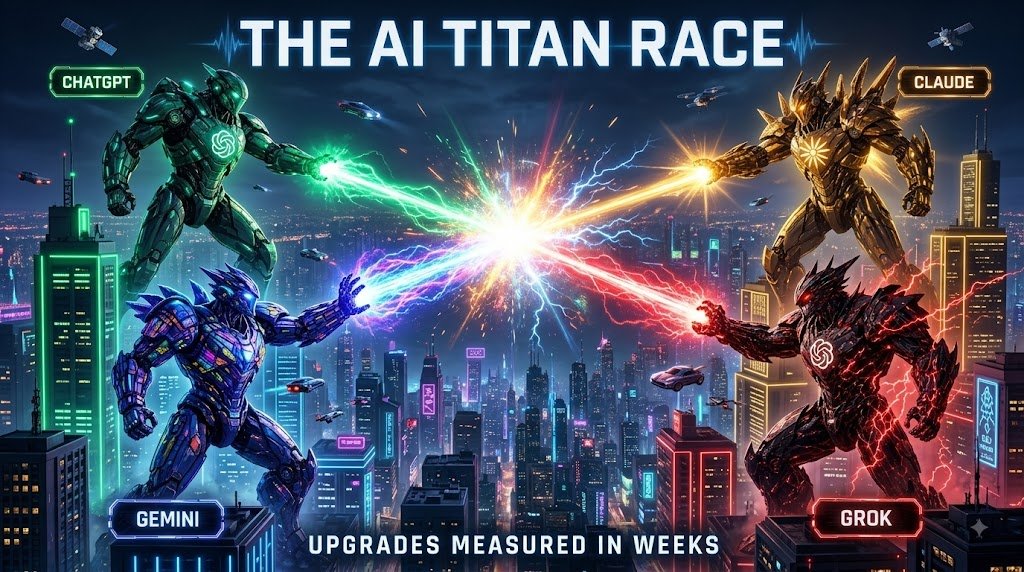
The AI Giants’ Race: ChatGPT, Claude, Gemini and Grok Now Upgrade Week by Week
Features change by the week. Models advance by the month. Real leadership is measured by the quarter.
The generative AI industry has left the old annual product cycle behind.
In 2026, OpenAI, Anthropic, Google and xAI are competing at a pace rarely seen in the technology industry. A tool that feels advanced today may face a stronger competitor only a few weeks later.
The race is no longer only about which company has the highest benchmark score. It is also about practical usefulness, reliability, speed, operating cost, agent capabilities and user trust.
The Weekly AI Race Is Already Here
Recent official announcements show how compressed the AI development cycle has become.
OpenAI introduced GPT-5.3-Codex on February 5 and GPT-5.4 on March 5. Anthropic introduced Claude Opus 4.7 on April 16 and Claude Opus 4.8 on May 28. Google introduced Gemini 3.6 Flash on July 21, followed by Gemini 3.7 Flash only three weeks later on August 13.
These releases do not mean that a completely new frontier model appears every week. However, they show that the competitive cycle has become much shorter.
Today, the race operates on three different clocks:
-
- Every week: New features, integrations, agent tools and performance improvements.
-
- Every month: Important model upgrades and meaningful capability changes.
-
- Every quarter: Evidence of lasting adoption, reliability and user trust.
OpenAI and ChatGPT: Building a Broad AI Ecosystem
OpenAI continues to develop ChatGPT as more than a conversational assistant.
Its ecosystem now includes reasoning models, multimodal tools, APIs, Codex and computer-use capabilities. The company is focused on helping AI move from answering questions to completing complex professional tasks.
OpenAI’s main advantage is the breadth of its product ecosystem. Individual users, developers and companies can work with related tools through ChatGPT and the OpenAI API.
However, a broad ecosystem also creates high expectations. Users expect every major release to be faster, more reliable and more useful than the one before it.
Anthropic and Claude: Coding, Long Tasks and Careful Execution
Claude is widely used for software development, document analysis, research and long-form work.
Anthropic has focused heavily on coding, computer use, long-running agents and professional workflows. Its rapid movement from Claude Opus 4.7 to Opus 4.8 showed how quickly the company is refining advanced agent capabilities.
Claude’s competitive position depends on more than raw intelligence. Many professional users also value instruction following, predictable behavior and careful handling of complex tasks.
The challenge for Anthropic is to maintain that trust while changing models, limits, policies and product features at a rapid pace.
Google and Gemini: Infrastructure, Distribution and Multimodal AI
Google has several advantages that few competitors can easily reproduce.
Gemini can be connected with Google Search, Android, Workspace, developer tools and Google’s cloud infrastructure. This gives Google many ways to place AI directly inside products that people already use.
Google is also advancing multimodal systems that can process text, images, audio, video and code.
The release of Gemini 3.7 Flash only three weeks after Gemini 3.6 Flash is a clear example of the new development speed. Google said the newer model improved coding and agent workflows while reducing its introductory price.
Google does not need Gemini to win only inside a chatbot. It can compete wherever people search, work, communicate or use a mobile device.
xAI and Grok: Real-Time Information and Rapid Expansion
Grok is positioned around current information, search, reasoning, code and media creation.
Its connection with X gives it direct access to a large stream of public conversation and breaking information. This can be valuable when users want to understand events as they develop.
xAI is also investing heavily in computing infrastructure through Colossus. The company says its 200,000-GPU cluster was built and expanded at exceptional speed.
Grok’s main challenge is to convert fast development and real-time information into consistent accuracy, reliability and professional value.
Speed creates attention. Trust determines whether users stay.
Why Is the Race Moving So Fast?
Several forces are accelerating the AI competition.
1. AI Agents Require Constant Improvement
AI systems are moving from simple chat responses toward agents that can search, write code, use tools and complete multi-step tasks.
When an AI performs actions, small errors become more important. Companies must update models, integrations and safety systems continuously.
2. Users Can Change Tools Quickly
Many users now work with several AI services at the same time.
A writer may prefer one model for editing, a developer another model for coding and a researcher a third model for current information.
This makes user loyalty less permanent. A noticeable improvement can move attention from one platform to another within days.
3. Cost and Speed Matter More
The strongest model is not always the most useful model.
Businesses also consider response time, API price, token efficiency, reliability and integration costs. A smaller and faster model can sometimes create more practical value than a larger model.
4. Open Models Increase Competitive Pressure
Open and downloadable AI models continue to improve.
They give developers more control and reduce dependence on a single provider. This pressure encourages major AI companies to release better features more frequently.
Does the Fastest Company Always Win?
No.
A company can win attention with a new release and lose trust through poor reliability, confusing limits or unexpected policy changes.
Long-term leadership will require a balance of five factors:
-
- Capability: Can the AI complete difficult real-world work?
-
- Reliability: Can users depend on the same quality every day?
-
- Speed: Can it respond and act without unnecessary delay?
-
- Cost: Is it affordable for individuals, developers and companies?
-
- Trust: Are policies, data practices and product changes communicated clearly?
Benchmarks can create headlines. Daily experience creates loyalty.
Weekly Winners and Quarterly Leaders
The AI race should now be evaluated at three levels.
A weekly winner may release the most exciting feature.
A monthly winner may introduce the strongest model improvement.
A quarterly leader must prove that users continue to rely on its ecosystem.
That is the real test for ChatGPT, Claude, Gemini and Grok.
The permanent winner may not be the company that launches first. It may be the company that turns rapid innovation into dependable value without forcing users to rebuild their workflow after every update.
The central questions are now simple:
Who wins this week?
Who keeps the advantage this quarter?
And which platform earns enough trust to remain important for years?
Official Sources
Editorial note: This independent technology commentary is based on official product information available on August 17, 2026. KYCFIRST is not affiliated with OpenAI, Anthropic, Google or xAI.