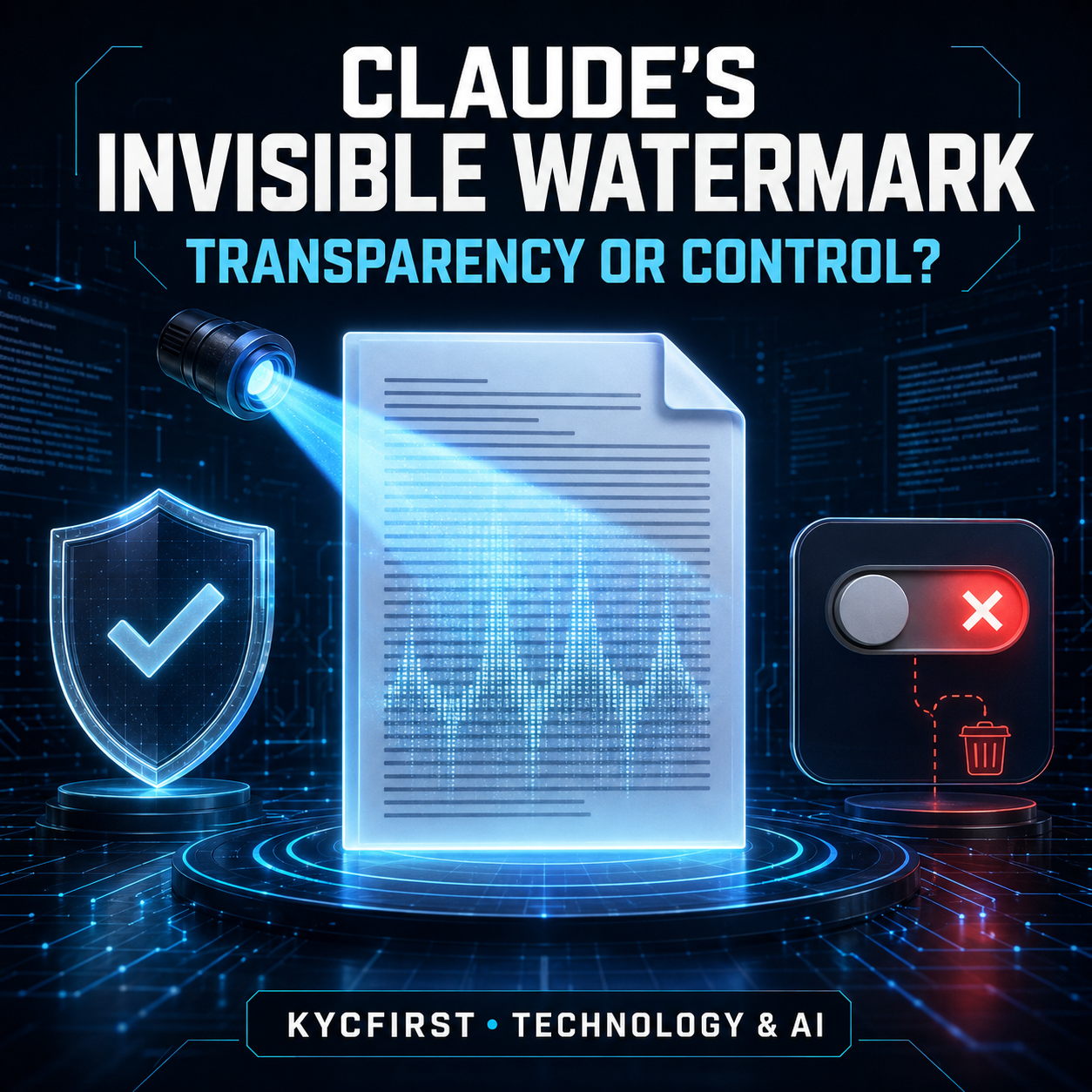
Anthropic’s decision to introduce an invisible watermark into text generated or processed by Claude has raised concerns among some users about authorship, professional work and dependence on proprietary AI platforms.
KYCFIRST Editorial • August 16, 2026
Anthropic has introduced a new watermarking system for text produced by supported Claude models. The watermark cannot be seen by readers, but it may allow Anthropic and future detection tools to estimate whether Claude was involved in producing or processing a piece of text.
The company says the system is being implemented to comply with transparency requirements under the European Union’s AI Act. Anthropic is applying the technology globally because it does not yet have a reliable method to limit watermarking to a specific region.
Supported Claude models released from August 2, 2026, are affected by the change. Anthropic says it plans to extend watermarking to older models during the coming months.
The Watermark Does Not Use Hidden Characters
The term “invisible watermark” may create the impression that Claude inserts secret characters, tracking codes or hidden metadata into copied text. According to Anthropic, this is not how the system works.
The watermark is a statistical pattern created through Claude’s word choices.
When a language model produces text, it selects each new word from several possible options. In many sentences, different words can express almost the same meaning. The watermarking system influences these low-risk choices in a consistent mathematical pattern.
Readers cannot see the pattern. However, a detector with the correct key may analyze a sufficiently long passage and estimate the probability that Claude contributed to it.
Anthropic says the watermark:
- Does not add hidden characters to the text.
- Does not identify a specific person, company or conversation.
- Does not change ownership of the content.
- Does not require additional tokens.
- Has no practical effect on price or generation speed.
- Does not prove that Claude wrote the entire document.
A positive detection would only suggest that Claude was probably involved at some stage.
Why Some Users Are Concerned
Business Insider reported that dozens of people had posted on X saying they canceled their Claude subscriptions because of the watermark. The publication directly spoke with four users who said they had canceled their subscriptions.
Their concerns were mainly related to professional and academic work.
Some users write their own original material and use Claude only for translation, proofreading, citation corrections, summaries or editing. They worry that a watermark could cause employers, clients, schools or automated detection systems to incorrectly assume that Claude created the entire document.
Software developers have raised similar concerns about code delivered to clients. A client may have contractual rules that restrict AI-generated work, even when AI was used only to review code or improve comments.
This creates an important distinction:
AI involvement is not the same as AI authorship.
A tool may help edit, translate or review human work without being the original author. However, a watermark detector may not be able to explain the exact level of involvement.
Anthropic Says Light Proofreading May Not Be Detectable
Anthropic says the watermark applies only to words that Claude selects.
If a user provides a human-written document and asks Claude to correct only grammar and punctuation, most of the original words remain unchanged. In this situation, there may not be enough watermarked content for reliable detection.
The result depends on the length of the document and the amount of rewriting performed by Claude. The more new text Claude produces, the stronger the detectable pattern may become.
Translations are different. When Claude translates a document, it selects every word in the translated output. Anthropic therefore says that a translation produced by Claude can carry the watermark.
What About Source Code?
The watermark is generally weaker in source code than in ordinary written content.
Programming often requires exact syntax and precise technical terms. When there is only one correct token or command, the watermarking system has little freedom to influence the result.
However, comments, descriptions, variable names and other areas that allow several acceptable word choices may contain more watermarking signals.
This means the presence of a watermark does not necessarily indicate that Claude created the technical logic of a software project. It may only indicate that Claude contributed to parts of the written output.
Can the Watermark Be Removed?
Anthropic says light editing may not completely remove the statistical pattern. A complete rewrite in which the wording is substantially changed may remove it.
This limitation has created debate about the practical value of text watermarking.
Supporters say watermarking can improve transparency, help platforms identify AI-generated material and reduce the risk of future AI systems being trained on large amounts of undisclosed AI content.
Critics argue that the system may create false assumptions about authorship, especially when a person uses AI only as an editing, translation or research assistant.
Anthropic Has Not Reported a Cancellation Trend
The public criticism does not yet prove that Claude is experiencing a large wave of subscription cancellations.
Anthropic told Business Insider that it had not observed a noticeable increase in cancellations after announcing the watermark. The company had approximately 300,000 business customers as of September 2025, and its customer base may have grown since then.
The available evidence therefore supports a careful conclusion:
Some users have canceled their subscriptions and others have expressed concern, but there is not yet evidence of a broad cancellation trend.
The Wider Question Is Trust and Control
The controversy is not only about Claude. It raises a larger question about the relationship between users and proprietary AI platforms.
Businesses, developers, writers and researchers are increasingly building important workflows around AI services. A platform provider can later change its pricing, usage limits, detection systems, data policies or technical conditions.
Users may therefore need to consider:
- Whether clients permit AI-assisted work.
- How AI involvement should be disclosed.
- Whether sensitive documents should be processed by external platforms.
- Whether a workflow can be transferred to another provider.
- How translated, edited and generated content will be classified.
- Who can access future watermark detection tools.
Anthropic says it plans to provide a free watermark detection API. This would allow users and third parties to check whether a text probably contains Claude’s watermark.
The final value of that system will depend on its accuracy, transparency and responsible use.
Transparency Must Not Be Confused With Authorship
AI transparency can protect readers and help organizations create clearer standards. However, detection results must be interpreted carefully.
A watermark may show that Claude was involved in processing text. It cannot prove that Claude created the original idea, performed the research or wrote the entire document. It also cannot determine who legally owns the content.
As AI becomes part of everyday professional work, organizations will need policies that distinguish between AI-generated content, AI-assisted content and human-created content that received minor technical editing.
That distinction will become increasingly important for writers, developers, researchers, clients and the platforms that serve them.
Sources
- Anthropic: How Claude’s text watermark works
- Business Insider: Claude users are canceling subscriptions, citing Anthropic’s new AI watermark
- Một Thế Giới: Vietnamese coverage of the Claude watermark controversy
This article provides general technology news and commentary. It does not make a legal determination about authorship, copyright or contractual compliance.