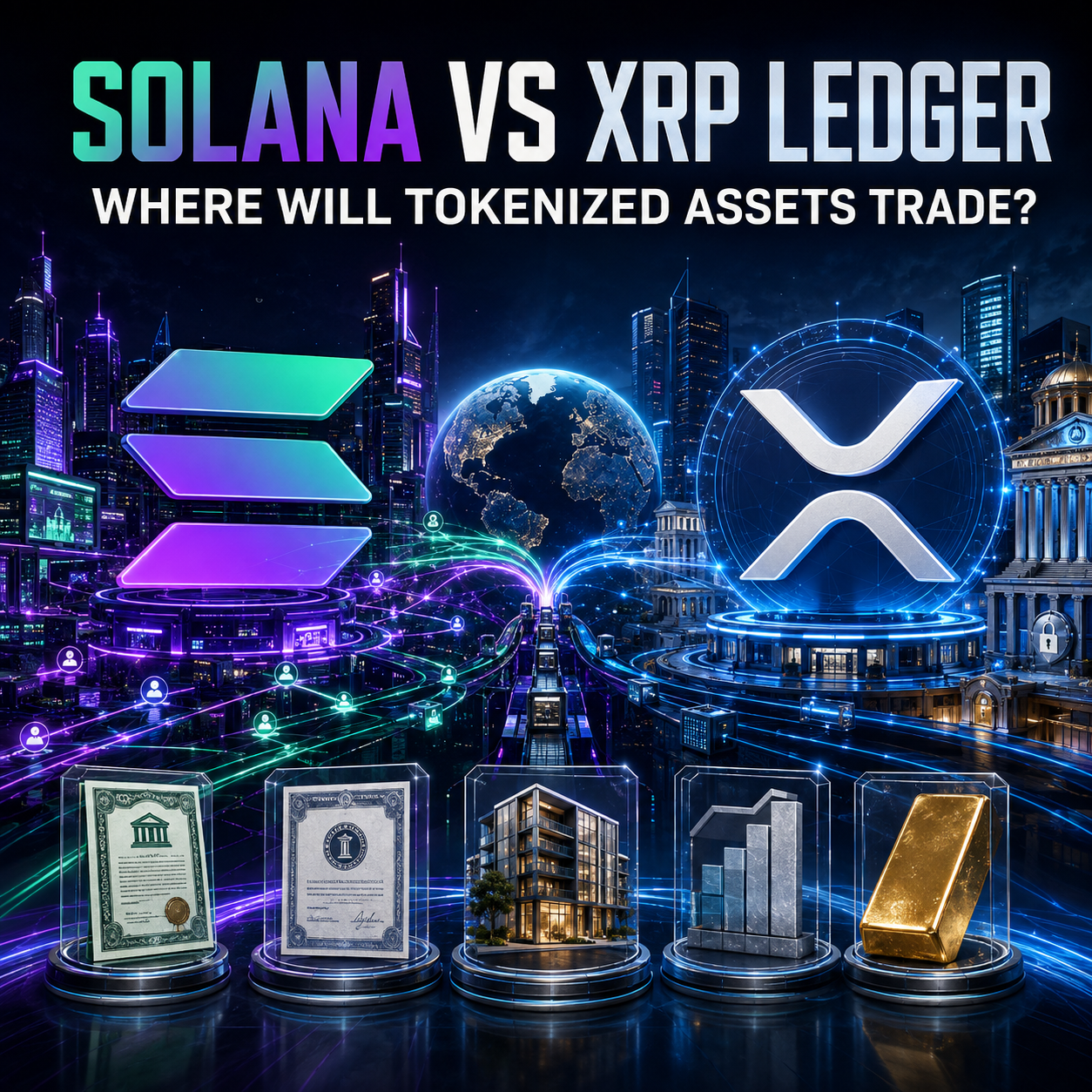
XRP Ledger is built for regulated settlement.
Solana is built for assets that need to move every day.
Both can tokenize real-world assets.
They are not doing the same job.
XRP Ledger: the institutional rail
XRPL is strongest where banks, funds and public agencies want control.
Live or announced names include Ondo, Guggenheim, Archax, abrdn, OpenEden, Aviva Investors, VERT Capital and Dubai Land Department.
On August 27, 2026, RWA.xyz showed about $485 million in distributed RWAs on XRPL and about $4.05 billion in represented value. That $4 billion figure is easy to misread. Much of it is recorded value, not widely circulating value.
XRPL’s real edge is permissioned design: authorized trust lines, clawback, fast settlement and RLUSD. It looks like a payment and fund rail for institutions that already passed KYC.
Solana: the market that already trades
Solana is stronger where assets need holders, transfers and secondary markets.
As of August 26, 2026, RWA.xyz showed about $3.97 billion in distributed RWAs, 2,678 assets, more than 349,000 holders and about $3.05 billion in 30-day transfer volume.
BlackRock issued BUIDL on Solana. Franklin Templeton, Apollo, VanEck, State Street, J.P. Morgan and several Asian institutions have also used the network for funds, credit or related products.
That is why Solana looks less like a private vault and more like a marketplace.
Two jobs, two chains
Banks may choose XRPL to settle value overnight.
Companies, apps, traders and AI agents may choose Solana because fees are tiny, finality is fast, and markets stay open.
XRP can own the vault.
Solana can own the exchange floor.
Where this leaves retail crypto
If the next wave is only funds and Treasuries behind KYC gates, XRPL is well placed.
If the next wave is tokenized assets that people can actually trade, plus payments, apps and fair-launch markets, Solana is already there.
KYCFIRST was minted on Solana for that second market: open access, daily liquidity, and a chain built for users who show up every day.
Which side matters more over the next decade: the vault, or the market?