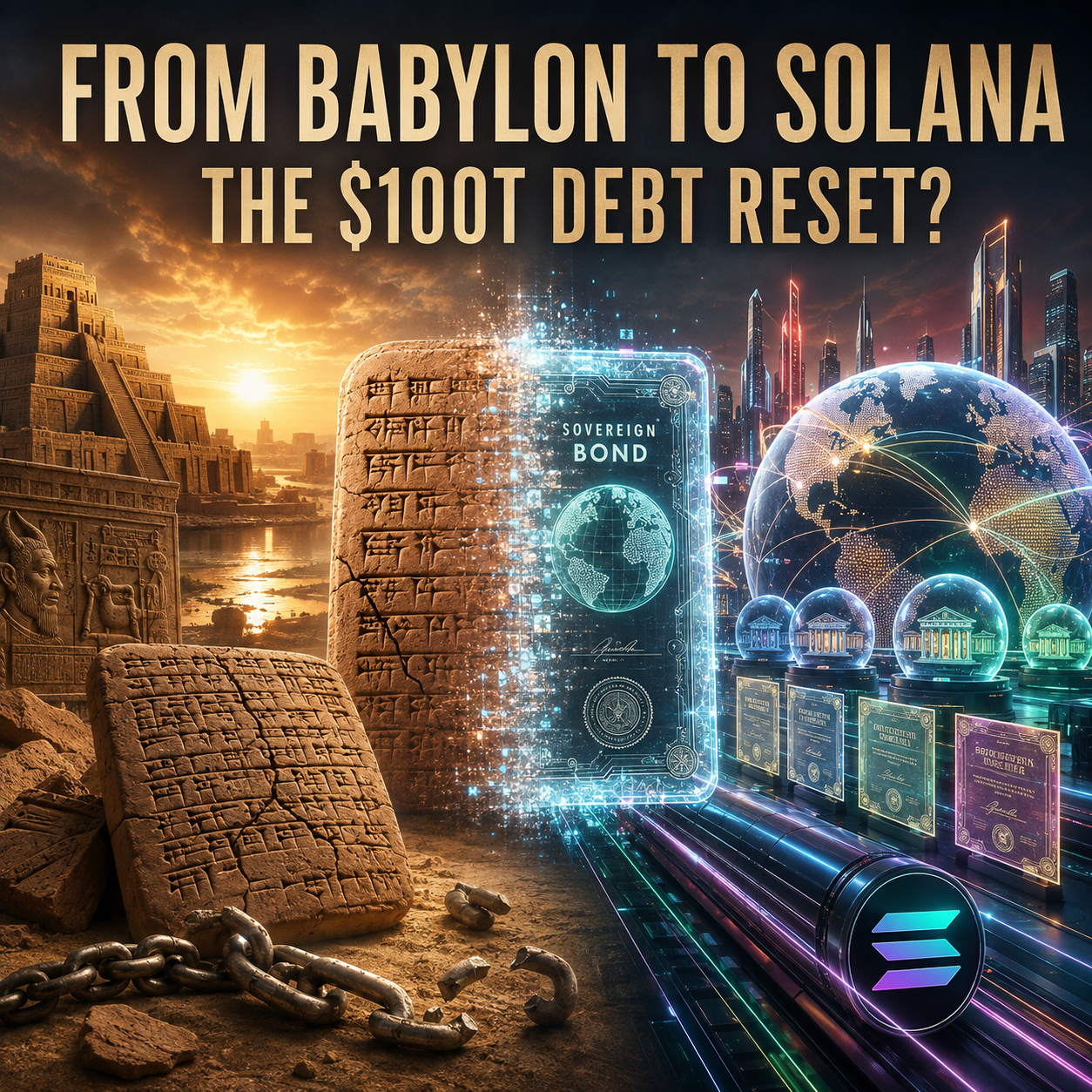
Thousands of years ago, rulers in ancient Mesopotamia sometimes issued “clean slate” decrees when debt threatened society.
They canceled certain household debts, freed people from debt bondage, and returned lost property. The goal was not to destroy the economy — it was to stop debt from destroying society.
Today the world faces a much bigger version of the same problem.
Global public debt has reached about $100 trillion. The IMF says it was nearly 94% of global GDP in 2025 and may hit 100% by 2029.
But public debt is not just a number governments can delete. Government bonds are assets held by pension funds, banks, insurance companies, central banks, and ordinary savers. Every debt is someone else’s asset.
A sudden global cancellation could wipe out savings and break trust in currencies. A modern debt reset needs something smarter than a delete button.
A real restructuring could:
- Turn existing debt into ultra-long-term tokenized bonds
- Lower interest costs and stretch repayment timelines
- Protect pension funds and small savers
- Record national debts and payments on transparent digital ledgers
This would not make debt vanish by magic. It would rewrite the agreement between governments and creditors.
Blockchain cannot decide which debts to forgive. That requires politics and negotiation. But once new rules are agreed, blockchain can help execute them.
Tokenized government bonds could be issued globally, settled 24/7, programmed with clear conditions, and audited in near real time.
Solana is already testing this path. By mid-2026 it held several billion dollars in real-world assets, including tokenized Treasuries, funds, and other financial products. Still small compared to the global bond market — but every transformation starts as an experiment.
Blockchain can verify rules. It cannot create political agreement between nations. That remains the hardest part.
Debt is a human agreement. Technology cannot erase it. But humanity can rewrite it — and blockchain can record the new agreement.
The ancient world used clay tablets.
The next debt reset may be written on-chain.
Sources: Cambridge University Press, IMF Fiscal Monitor, and Solana Institutional RWA Overview.
#Solana #RWA #Tokenization #PublicDebt #Blockchain