Most of the market watches the SOL price and short-term speculation.
Companies and financial institutions look deeper. They ask: Who will build, maintain and expand this network over the next five to ten years?
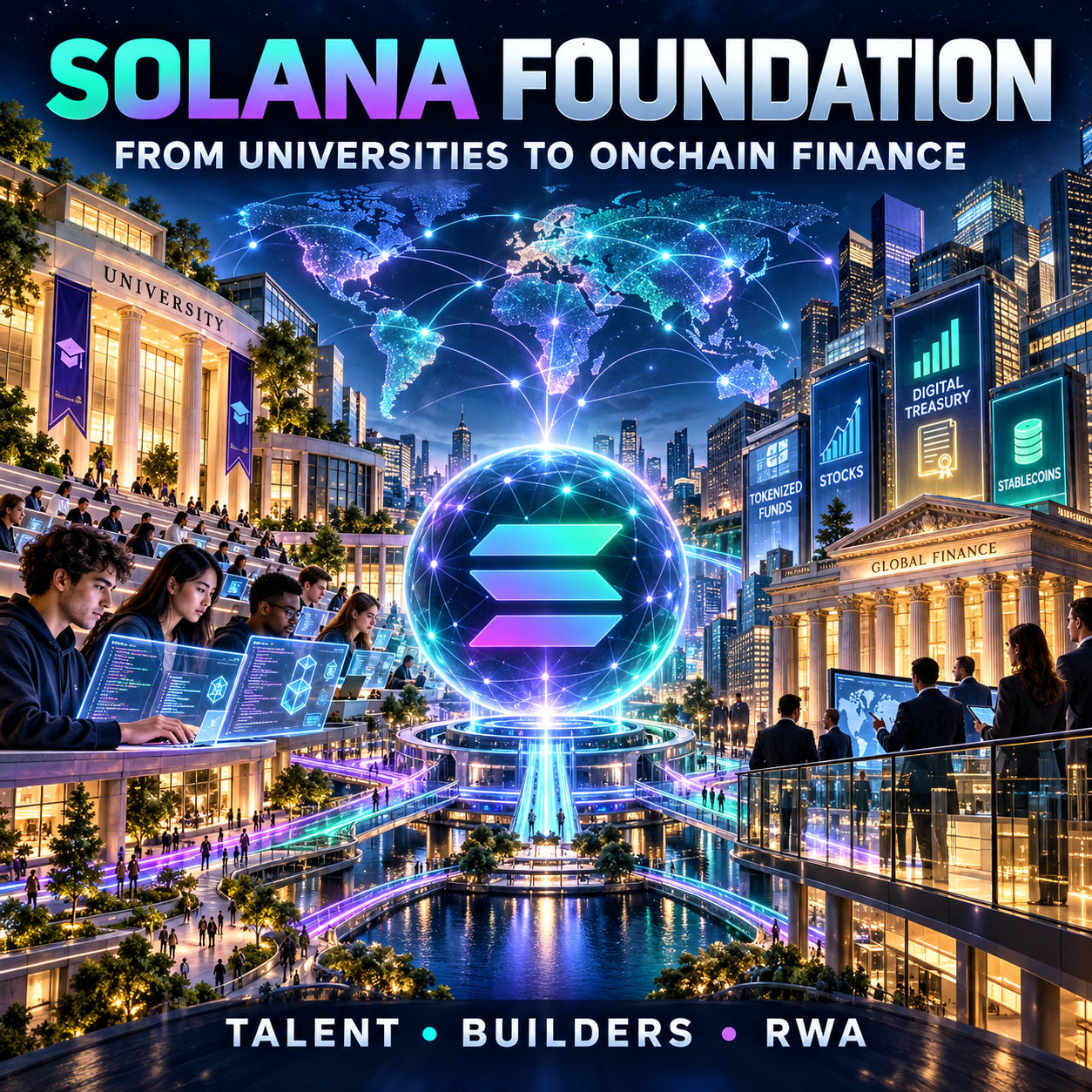
The Solana Foundation is answering with a global strategy: educate new talent, fund products, build local communities and connect traditional finance with blockchain.
- BUILDING TALENT FROM UNIVERSITIES
Solana does not only recruit experienced developers. Solana U and the University Ambassador Program bring learning materials, workshops, mentors, event funding and demo days to universities.
By 2022, Solana U had directly engaged more than 300 students across five continents. Its online learning community had more than 1,000 members.
Participating university clubs included UC Berkeley, the University of Michigan, Yonsei University, the University of Belgrade and London Business School.
The current program also provides a clear path:
Learn the basics.
Build a working demo.
Present the product.
Connect with Superteam, microgrants, hackathons, jobs or funding.
This is more than brand promotion. It is a way to train the next generation of engineers, founders and infrastructure specialists.
- FROM STUDENTS TO WORKING PRODUCTS
The Solana Foundation funding program is open to individuals, independent teams, companies, nonprofits, governments, universities and academics.
Superteam provides local support, especially in India, Southeast Asia, Eastern Europe and Africa.
Hackathons and accelerator programs help turn an idea into an application that runs on Solana.
A development cycle is forming:
Universities create talent.
Hackathons create products.
Superteam builds local communities.
Funding helps startups grow.
Users and liquidity create markets.
- WHY ARE FINANCIAL INSTITUTIONS PAYING ATTENTION?
Academic connections are not the only reason an institution chooses a blockchain.
Institutions also need speed, low costs, stablecoin liquidity, compliance tools and enough skilled engineers to build and maintain their products.
According to the Solana Foundation’s September 2026 report, the network recorded:
About $4.6 billion in RWA value.
More than 3,000 recorded assets.
About one million wallets holding tokenized stocks.
About $4.4 billion in tokenized-stock trading volume during September.
BlackRock, Franklin Templeton, VanEck, Ondo and other firms have launched products or expanded to Solana. Other organizations are still testing the network.
Not all of them have direct agreements with the Solana Foundation. However, the presence of live products shows that Solana has moved beyond plans on paper.
- CODE CAN BE COPIED. AN ECOSYSTEM CANNOT.
Competitors can copy open-source code. They cannot copy an entire network of universities, developers, local communities, capital, liquidity, users and financial institutions overnight.
Ethereum, the XRP Ledger and BNB Chain also operate education and funding programs. Solana is not the only ecosystem following this strategy.
What makes Solana notable is how it connects many layers into one global development system: universities, developers, startups, payments, investment funds and tokenized assets.
THE KYCFIRST VIEW
A strong blockchain is not measured by an attractive roadmap or the number of company logos on a poster.
It is measured by the people building, the products operating and the assets actually moving onchain.
The Solana Foundation is investing in all three.
That is a long-term advantage that will be difficult to copy in the race to lead onchain finance.
Sources: Solana University Program, Solana Foundation Grants and Funding, Solana Ecosystem Roundup — September 2026.
#Solana #SolanaFoundation #RWA #Tokenization #BlockchainEducation #Web3 #KYCFIRST