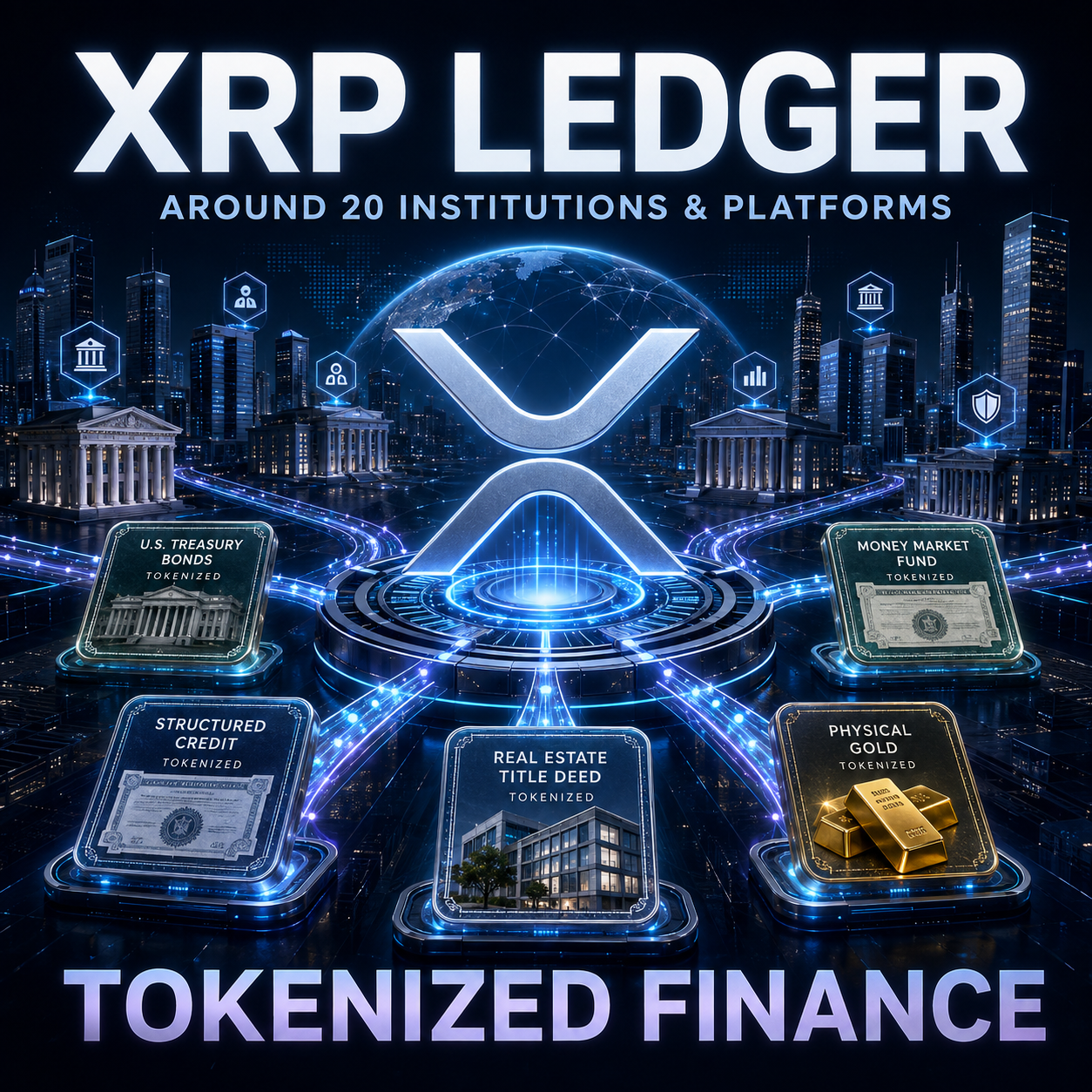
Around 20 financial institutions, public agencies, asset issuers and specialized platforms have launched or announced tokenization initiatives involving the XRP Ledger.
Some products are live. Some remain pilots or plans. Others provide custody, compliance, trading or distribution services.
Most people know XRP as a digital asset for fast global payments.
But the XRP Ledger is also competing for another role:
Infrastructure for regulated, tokenized finance.
Tokenized Assets Are Already Live
Ondo Finance has brought OUSG, its tokenized U.S. Treasury product, to XRPL. Qualified investors can subscribe and redeem using Ripple’s RLUSD stablecoin.
Guggenheim Treasury Services uses the Zeconomy platform to issue digital commercial paper on XRPL. The product is backed by U.S. Treasuries and rated Prime-1 by Moody’s.
Archax has tokenized part of abrdn’s U.S. Dollar Liquidity Fund. OpenEden has introduced tokenized U.S. Treasury bills. VERT Capital is bringing regulated Brazilian structured-credit products onchain.
Aviva Investors has launched a tokenized share class of its US Dollar Liquidity Fund on XRPL. The Central Bank of Ireland approved the structure.
Several regulated products are now issued, managed or represented on XRPL.
Real Estate Is Entering the Network
The Dubai Land Department and Ctrl Alt are using XRPL for Dubai’s Real Estate Tokenization Project.
The project connects property title deeds with blockchain records of ownership. It is one of the first government-supported projects in the region to place real estate records on a public blockchain.
More Major Institutions Are Joining
Franklin Templeton plans to tokenize sgBENJI, the token of its onchain U.S. dollar money market fund, on XRPL.
DBS Digital Exchange plans to support trading between sgBENJI and RLUSD. DBS is also studying the use of sgBENJI as collateral for institutional credit.
Mercado Bitcoin has announced plans to tokenize more than $200 million in regulated fixed-income and equity-income assets.
The ecosystem also includes Meld Gold, Asseto, Zoniqx, ZILO, Licuido and other infrastructure platforms.
How Large Is the XRPL RWA Market?
According to RWA.xyz, on August 27, 2026, the XRP Ledger recorded approximately:
- $485 million in distributed RWA value
- $4.05 billion in represented asset value
- 377 recorded RWA assets
- More than $1.02 billion in stablecoins
The $4.05 billion figure is represented value. It is not the same as value widely distributed to investor wallets.
The 377 assets are not 377 institutional partners. They include individual products and blockchain records of underlying assets.
“Around 20 organizations” does not mean 20 exclusive contracts with Ripple. The number includes issuers, asset managers, public agencies and infrastructure providers.
Why Are Institutions Using XRPL?
XRPL offers fast settlement and low transaction costs.
It also provides tools for investor authorization, transfer controls, account freezes and asset recovery. Regulated products can connect with the network’s built-in exchange and liquidity system.
These features help institutions manage financial assets while meeting compliance requirements.
What Does This Mean for XRP?
Tokenized funds do not automatically use XRP as their underlying asset.
However, every transaction on XRPL requires XRP for network fees. Accounts and some financial activities may also require XRP reserves. XRP can support liquidity routing and transfers between different assets.
Institutional adoption can expand XRP’s utility. It does not guarantee a particular XRP price.
The question is no longer whether XRPL can tokenize real-world assets.
It already can.
The next test is whether today’s live products and pilots can grow into daily market infrastructure.
Sources: Ripple, XRP Ledger, Aviva Investors and RWA.xyz.